1) The Big Idea in One Sentence
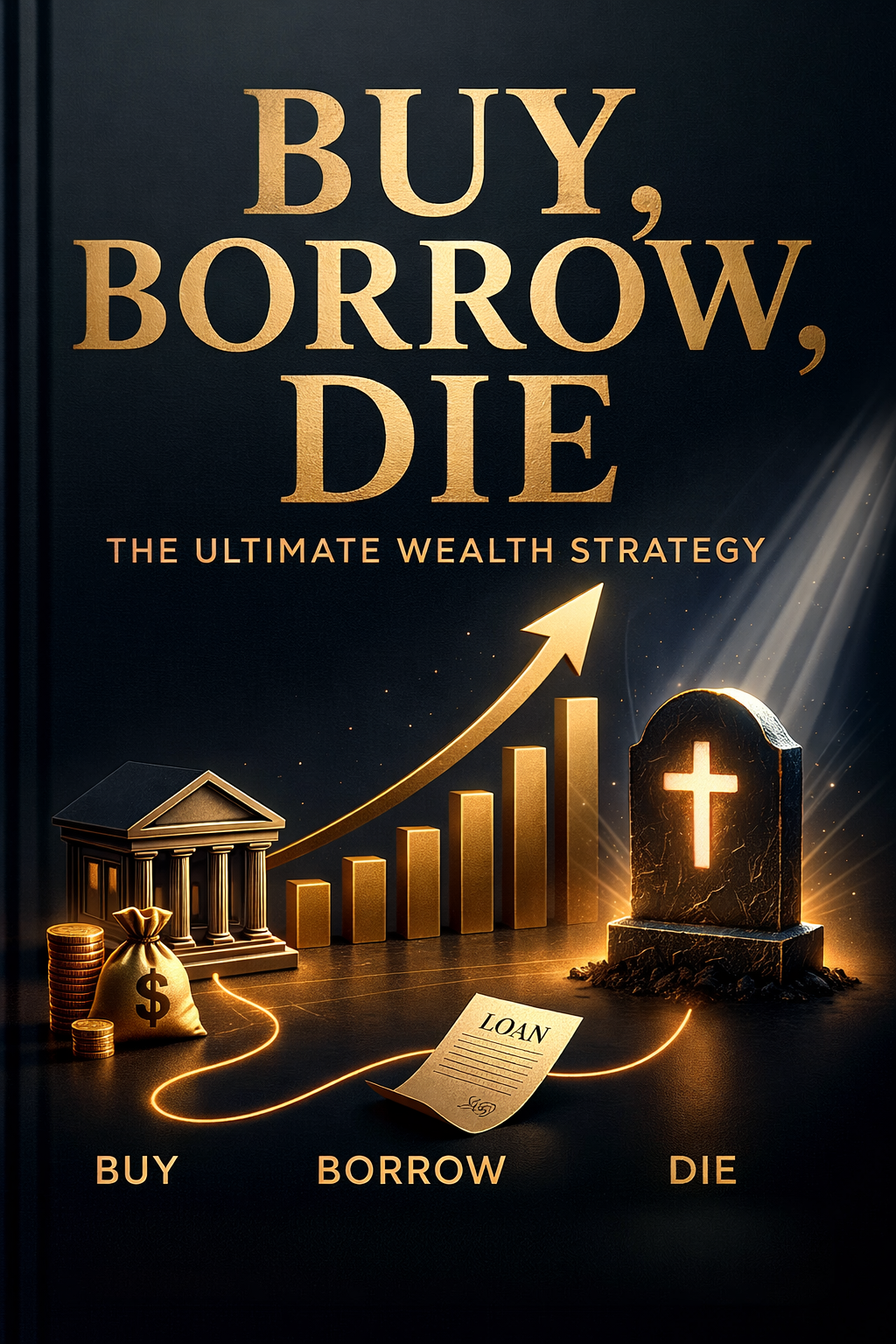
Buy assets that grow in value → Borrow money using those assets as collateral (instead of selling) → Die and (often) your heirs get a new tax basis (a "step-up"), which can reduce capital gains taxes when they sell.
2) The Strategy Explained in Simple Terms
Imagine you have a magic tree.
- You buy the tree (asset).
- The tree grows bigger (value rises).
- You do not cut the tree down (you don't sell).
- Instead, you borrow money by showing the bank your big tree (collateral).
- Later, when you die, the tree's "starting value" can reset for your kids (step-up), so they may owe less tax if they sell.
3) The 4 Building Blocks You Must Understand
A) Appreciation (the value goes up)
This strategy only "works" if your asset tends to rise over time.
B) Unrealized gains (you gained, but you didn't "cash out")
If your asset went from $100k to $300k, you have a $200k gain on paper. In many systems, you typically don't owe capital gains tax until you sell.
C) Basis (your tax starting point)
Your basis is the number used to calculate tax when you sell. IRS explains basis as generally what you paid (plus adjustments).
D) Stepped-up basis at death (the "Die" part)
For many inherited assets, the basis is generally the fair market value at the date of death (or an alternate valuation approach in some estates). This is the famous "step-up."
4) Why the Strategy Exists (The Real Engine)
The fundamental driver is:
- Deferring gains (not selling)
- Borrowing instead of selling (accessing cash without realizing gains)
- Stepped-up basis at death (potentially wiping out the built-up gain for heirs)
5) What You "Buy": The Asset Menu (What Works Best)
Common "Buy" assets used in real life
- Public stocks / index funds (long-term growth, easier collateral at broker/bank)
- Real estate (rents can help service debt; may refinance repeatedly)
- Private businesses (harder lending, more risk, but big upside)
- Collectibles / niche assets (usually harder to borrow against; more specialized)
Rule of thumb: The best "Buy" assets are stable enough that lenders feel safe lending against them.
6) Who This Strategy Is For (and Not For)
Better fit if you:
- Can hold assets long-term (5–30+ years)
- Have good credit and stable cash flow
- Can tolerate market drops without panic-selling
- Don't need to sell to pay bills
Bad fit if you:
- Live paycheck-to-paycheck
- Would be crushed by a margin call / forced sale
- Need guaranteed liquidity
- Don't want debt (psychologically or financially)
7) The Full Step-by-Step System (Start to Finish)
Phase 1 — Build the Foundation (Before You Buy)
Step 1: Build your "money safety net"
Emergency fund (so you don't borrow against investments for surprises)
Step 2: Kill toxic debt
High-interest consumer debt usually beats "fancy strategies."
Step 3: Learn your tax basics
Capital gains, basis, inheritance basics, and your state rules.
Step 4: Pick your asset lane
Stocks? Real estate? Business? Don't mix strategies until you master one.
Phase 2 — BUY (Acquire Assets That Grow)
Step 5: Buy assets with a long time horizon
The point is growth over time, not quick flips.
Step 6: Use smart ownership structure (basic level)
Individual ownership is simplest.
More advanced: LLCs, trusts, etc. (covered later)
Step 7: Protect the downside
Insurance (especially for real estate), diversification (especially for stocks).
Phase 3 — GROW (Let Assets Appreciate)
Step 8: Hold and let compounding work
"Buy, Borrow, Die" is a patience strategy.
Step 9: Avoid selling as your default cash plan
Selling triggers gains and potential taxes.
Step 10: Track your basis and records
If you don't track basis, you can overpay taxes later. IRS emphasizes basis as essential for gain/loss calculation.
Phase 4 — BORROW (Access Cash Without Selling)
This is where people get hurt if they don't understand the risks.
Step 11: Choose your borrowing method
Common borrowing routes:
- Securities-Based Lending (SBL) / portfolio line of credit
Uses taxable brokerage investments as collateral.
Note: retirement accounts generally can't be used as collateral for these loans (common lender rule). - Margin loans
Borrowing through a brokerage margin account. - Real estate loans
Cash-out refinance, HELOC, blanket loans, etc.
Step 12: Understand collateral rules and restrictions
If borrowing is secured by "margin stock," lenders can be subject to Regulation U restrictions (purpose credit rules, margin requirements, etc.).
Step 13: Decide why you're borrowing
Smart uses (conceptually):
- Buying more cash-flowing assets
- Funding business expansion with predictable returns
- Paying taxes strategically (ironically, sometimes borrowing helps you avoid selling at the wrong time)
Risky uses:
- Lifestyle inflation (cars, luxury, recurring expenses)
- Borrowing to speculate
- Borrowing with no repayment plan
Step 14: Build a repayment plan (the "adult part")
You must answer:
- How will interest be paid?
- What happens if the collateral drops 30–50%?
- What is the "exit" plan if rates rise?
Step 15: Control the #1 danger—forced liquidation
With securities-based loans and margin-like structures, a market drop can trigger margin calls or forced selling at bad prices. This is a known risk discussed by lenders/industry commentary.
Phase 5 — MAINTAIN (Run the Strategy Like a Business)
Step 16: Monitor loan-to-value (LTV) like a hawk
If asset value falls, LTV rises = danger.
Step 17: Keep "liquidity buckets"
- Cash bucket (0–12 months)
- Safe income bucket (1–3 years)
- Growth bucket (3–10+ years)
Step 18: Stress test your plan
Ask:
- What if markets drop 40%?
- What if interest rates jump?
- What if your income stops for 6 months?
Step 19: Avoid cross-collateral chaos
Pledging the same assets in multiple ways can create domino problems.
Phase 6 — DIE (Estate Transfer and the Step-Up Concept)
Step 20: Understand what happens at death (high level)
Often, inherited assets receive a basis that is generally the fair market value at death, which can reduce taxable gain for heirs.
Step 21: Plan for estate taxes (if you're above thresholds)
The federal estate "basic exclusion amount" changes over time. The IRS announced that estates of decedents who die during 2026 have a basic exclusion amount of $15,000,000.
(That doesn't mean "no tax ever"—it means estate tax applies above that amount, plus there are state-level possibilities.)
Step 22: Decide what heirs do with the debt
Common outcomes:
- Estate uses cash flow to keep paying
- Heirs refinance
- Estate/heirs sell some assets to pay off loans (hopefully with reduced gains due to step-up concept)
8) A Full Worked Example (Simple Numbers)
Scenario
- You buy stock index fund: $100,000
- 20 years later it's worth: $500,000
- Unrealized gain: $400,000
Option A: Sell to get $200,000 cash
- You sell $200,000 worth
- Part of that sale is gain → capital gains tax may apply.
Option B: Borrow $200,000 against the portfolio
- You don't sell
- You may avoid realizing gains now
- You pay interest, and you accept collateral risk.
"Die" step-up concept
If the owner dies, inherited basis is generally the FMV at death (commonly described as step-up), so the $400,000 built-up gain may not be taxed the same way it would have been if sold during life (depending on specifics).
9) The Hidden Costs People Ignore
Cost 1: Interest (the strategy isn't "free")
Borrowing costs money. Rates can rise.
Cost 2: Market risk (the strategy can break fast)
If assets drop sharply, lenders may require more collateral or force sales.
Cost 3: Concentration risk
A billionaire can borrow against one giant position and survive volatility.
A normal person often can't.
Cost 4: Law-change risk
Policy experts explicitly discuss reforms that could reduce or eliminate advantages that power "buy-borrow-die."
10) Risk Management Rules (Non-Negotiable)
- Don't borrow your lifestyle.
- Keep LTV conservative. (Lower LTV = less liquidation risk)
- Have cash reserves for calls.
- Borrow against diversified assets, not one bet.
- Re-check the deal terms yearly.
- Assume a 30–50% drawdown can happen. (Markets do that.)
11) The "Business Owner Version" (Using It Inside Businesses)
Many business owners effectively do:
- Buy: build/own equity in a business
- Borrow: loans using business assets/cash flow, or borrowing personally using business equity/other assets
- Die: transfer ownership via estate plan
Key difference: private businesses are harder to borrow against and risk can be higher.
12) Tools, Documents, and Tracking (Make It a System)
Your "Buy, Borrow, Die" file folder
- Asset list (what you own, where)
- Cost basis records
- Loan agreements + terms
- LTV tracker (monthly)
- Interest payment plan
- Estate documents list (will/trust/beneficiaries)
- Insurance policies (life, property, umbrella)
Monthly checklist (10 minutes)
- Current asset value
- Current loan balance
- LTV %
- Upcoming interest due
- Cash reserve status
- Any big market moves?
13) Common Questions (Quick Answers)
Q: Is this legal?
A: The concepts described are legal when done properly. The big idea is deferring realization of gains, borrowing against assets, and inheritance basis rules.
Q: Do only billionaires use it?
A: They use it the most because they have big appreciating assets and can survive volatility. But versions exist for regular investors—risk is the limiter.
Q: What's the biggest danger?
A: Forced liquidation (margin calls / collateral calls) during downturns.
Q: Does step-up apply to everything?
A: Often inherited property basis is generally FMV at death, but details vary by asset type, estate situation, and law.
14) Mini "Course Workbook" (Copy/Paste Pages)
Page 1 — My Strategy Snapshot
Page 2 — Risk Stress Test
If my assets drop 40%, then:
Page 3 — Estate Plan Basics (Starter List)
15) Final Summary (The Whole Strategy in 9 Lines)
- Buy assets that tend to rise.
- Hold them for years.
- Avoid selling when you need cash.
- Borrow against the assets instead.
- Keep LTV conservative.
- Pay interest from cash flow (not panic selling).
- Maintain liquidity for downturns.
- Have an estate plan.
- Understand inheritance basis rules and estate tax thresholds can matter.